




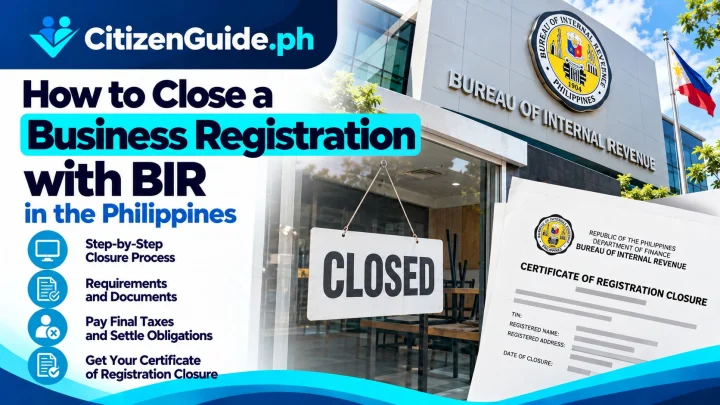









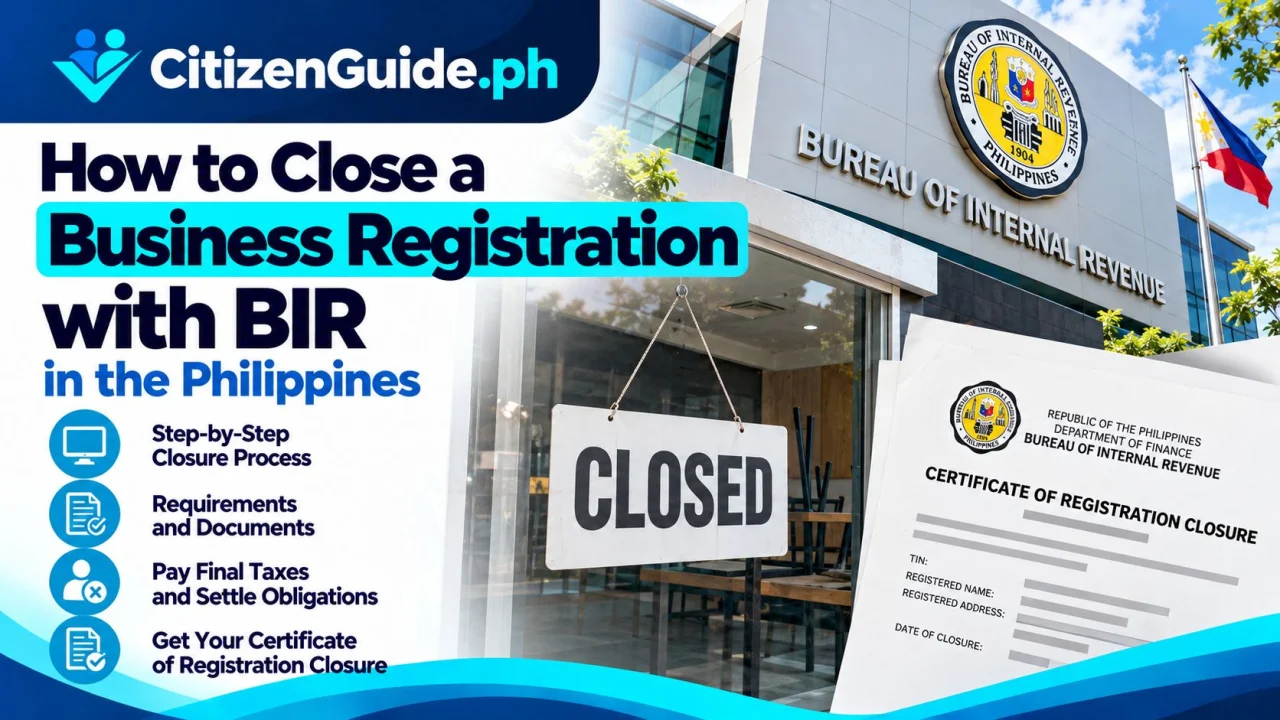
Stopping business operations does not automatically close a taxpayer’s registration with the Bureau of Internal Revenue. A registered business should formally apply for closure/cancellation so the BIR can deregister the applicable tax types, settle open cases or liabilities, and complete the tax-clearance process.
In May 2026, BIR issued Revenue Memorandum Circular No. 47-2026, which streamlined the closure and cancellation procedure for business taxpayers.
Who is covered by the 2026 closure rules?
The circular applies broadly to registered business taxpayers that permanently cease operations or otherwise need business-registration cancellation. This includes individual businesses and professionals, digital/online businesses, corporations, partnerships and other juridical entities, and other registered business taxpayers.
Where can you file?
Submit the application to the RDO where the Head Office or Branch Office is registered. RMC No. 47-2026 allows filing:
- Electronically using the taxpayer’s officially registered email address to the concerned RDO’s official email;
- Through available BIR electronic registration facilities such as the TRRA Portal or ORUS; or
- Manually at the concerned RDO.
However, the circular requires certain physical items—such as unused invoices/accounting forms and original BIR notices or permits—to be submitted manually when applicable.
Core documents under RMC No. 47-2026
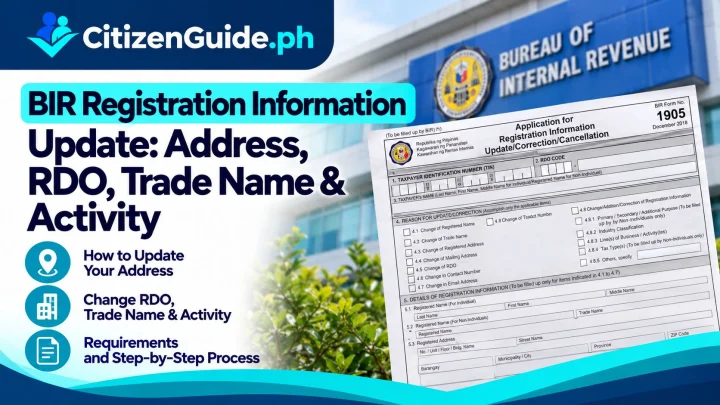
- BIR Form No. 1905 — Application for Registration Information Update/Correction/Cancellation, two original copies.
- Ending inventory of goods and supplies, including capital goods, for VAT-registered taxpayers.
- Unused invoices/supplementary documents and other unutilized accounting forms, together with their inventory, when applicable.
- Original BIR notices and permits issued to the taxpayer, as applicable, such as the Certificate of Registration/eCOR, ATP, Notice to Issue Invoice, POS/CRM accreditation or permit, and EIS authorization records.
- Authority/identification documents if a representative files the closure.
- For closure due to death of an individual proprietor, the death certificate and documents establishing the authority of the heir/executor/administrator.
Step 1: File all final or short-period tax returns
The taxpayer must file the final or short-period returns for applicable tax types covering the period from the beginning of the taxable year up to the closure date and pay taxes due. RMC No. 47-2026 also states that zero returns should be filed for covered periods with no business activity.
Step 2: Prepare Form 1905 and the closure documents
Complete the cancellation/update portion of Form 1905 and prepare the supporting items that apply to the business. Create a clear inventory of unused invoices and accounting forms before surrendering the physical items.
Step 3: Submit through the allowed BIR channel
Use the current channel accepted by the RDO. Even when the initial application is sent electronically, be prepared to surrender the original physical documents and unused forms that the circular specifically requires to be submitted manually.
Step 4: Resolve any open cases or tax liabilities
BIR checks the taxpayer’s registration record, filing compliance, and outstanding liabilities. Respond promptly to findings. A taxpayer who simply stops operating without completing BIR closure remains responsible for continuing tax obligations, including returns and applicable penalties, until the closure requirements are completed.
When does BIR deregister the tax types?
RMC No. 47-2026 states that the taxpayer’s registration is cancelled upon filing and submission of the complete closure requirements. The registered form types are placed under deregistered status so that new open cases do not continue to be generated after the complete requirements are submitted.
Tax-clearance timeline for qualifying smaller taxpayers
Under RMC No. 47-2026, micro taxpayers or taxpayers whose gross sales for the immediately preceding year do not exceed ₱3 million, or whose gross assets upon retirement do not exceed ₱8 million, can receive the tax clearance within three working days from submission of complete requirements if there are no open cases/outstanding liabilities—or within three working days after complete submission and settlement of outstanding tax liabilities.
Those taxpayers are not subject to a mandatory closure audit under the circular.
When can closure take longer?
If the taxpayer has a pending audit under a Letter of Authority, or exceeds the sales/assets thresholds stated in RMC No. 47-2026, the tax clearance and final closure process is completed only after the required audit is terminated. Time spent by the taxpayer completing missing requirements or settling liabilities is also outside a normal office-processing estimate.
Common mistakes to avoid
- Closing the store or cancelling the DTI/SEC registration but forgetting the separate BIR closure.
- Failing to file final/short-period returns.
- Discarding unused invoices or original BIR permits before the RDO has processed the closure requirements.
- Ignoring open cases or outstanding tax liabilities.
- Assuming an emailed application means no physical surrender of applicable documents is required.