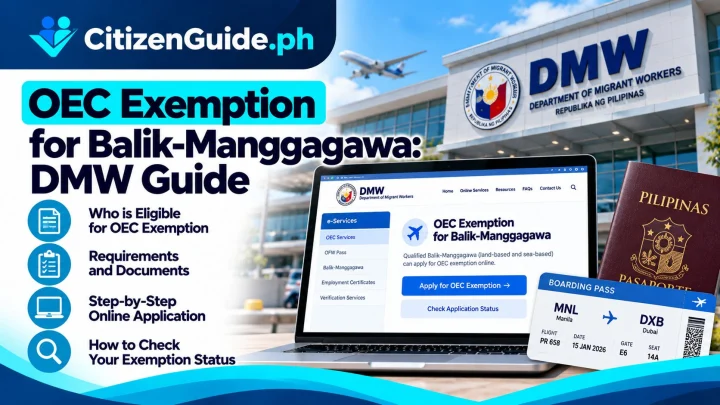





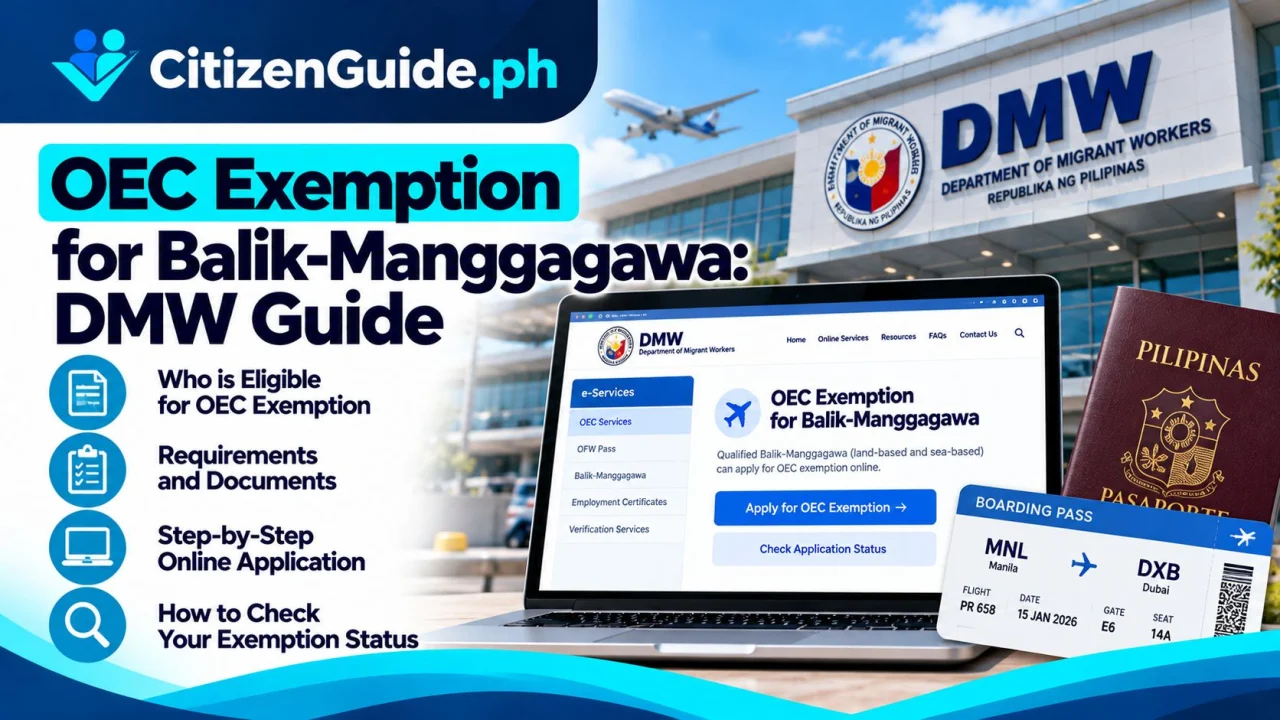
An OEC exemption for Balik-Manggagawa applies only when the returning worker meets the current DMW conditions. Workers with changed employers, job sites or records may need a different OEC process.
An Overseas Employment Certificate (OEC) is a DMW document used as proof of documented overseas employment and as an exit-clearance document for covered OFWs. Returning OFWs, commonly called Balik-Manggagawa, use the DMW online processing system to determine whether they qualify for an OEC exemption or must complete an OEC appointment/evaluation.
Who is a Balik-Manggagawa?
DMW guidance covers returning OFWs who are going back to an existing overseas job. Current DMW regional guidance lists common cases such as returning to the same employer and same job site, returning to the same employer at a new job site, or returning to an employer that the worker transferred to while already abroad.
Prepare these initial documents
- Valid passport.
- Valid work visa or work permit.
- Verified/authenticated employment contract when required for the case.
- DMW eRegistration account and updated worker information.
- Other proof of existing employment if requested during evaluation.
Step 1: Sign in to DMW eRegistration
Go to the official DMW Online Services portal and sign in to your eRegistration account. Keep your personal, passport, employer, and contract information accurate.
Step 2: Open the Balik-Manggagawa service
Select the Balik-Manggagawa transaction and answer the employment questions carefully. The system uses your answers and worker record to determine the next step.
Step 3: Check whether you qualify for OEC exemption
Workers returning under qualifying employment circumstances and with the required DMW record may be able to generate an OEC Exemption online. If the system determines that evaluation is required—for example because of changed employment details or another exception—follow the appointment instructions.
Step 4: If appointment is required, bring the documents
DMW’s Balik-Manggagawa requirements commonly include the passport, verified/authenticated employment contract, work visa/work permit, and proof of continuing employment. Bring the documents specified by your appointment confirmation because requirements can differ by employment circumstance.
OEC validity
Current DMW regional guidance states that an issued OEC is generally valid for 60 days from issuance for one exit from the Philippines. Do not process it too early if your travel date is still far away, and always follow the validity shown on your actual document.
Do not use an OEC from the wrong employment record
If your employer, job site, position, visa, or contract situation changed, update the DMW record and follow the proper evaluation route. Incorrect employment details can create airport or deployment problems.
Common mistakes to avoid
- Waiting until the travel date to resolve a DMW record problem.
- Using an expired passport or work visa.
- Declaring the same employer/job site when the actual employment details changed.
- Paying unofficial fixers for OEC or exemption processing.
- Forgetting that the OEC is normally for one exit and has a stated validity period.
Official sources
OEC issuance and OEC exemption are two different outcomes
Returning OFWs should first identify whether the current DMW system treats the trip as an exemption case or requires an OEC transaction. Do not assume that having worked abroad before automatically means you are exempt.
| Your case | What to check first |
|---|---|
| Same employer/jobsite and record is current | Check whether the current Balik-Manggagawa workflow confirms exemption for the trip. |
| Employer, jobsite, position, or contract situation changed | Expect additional verification or an OEC-processing route rather than relying on a prior exemption. |
| Your old POEA/DMW record is missing or mismatched | Resolve the worker/eRegistration record before creating duplicate accounts or repeated transactions. |
| You already generated a travel-related result | Save it and verify validity/travel details before starting another application. |
Before going to the airport
Keep the current DMW result, passport, employment/travel documents, and any supporting records required by your case. Recheck the validity and trip details close to departure so an old screenshot or expired transaction does not become the reason for a travel delay.